Automated Data Quality at the Point of Registration
Every compound registered in Labguru goes through a three-step quality pipeline automatically. No manual review process, no additional configuration required.
- Structure validation checks every compound for critical errors including invalid elements, impossible bonds and unreadable files, and blocks registration before bad data enters the database
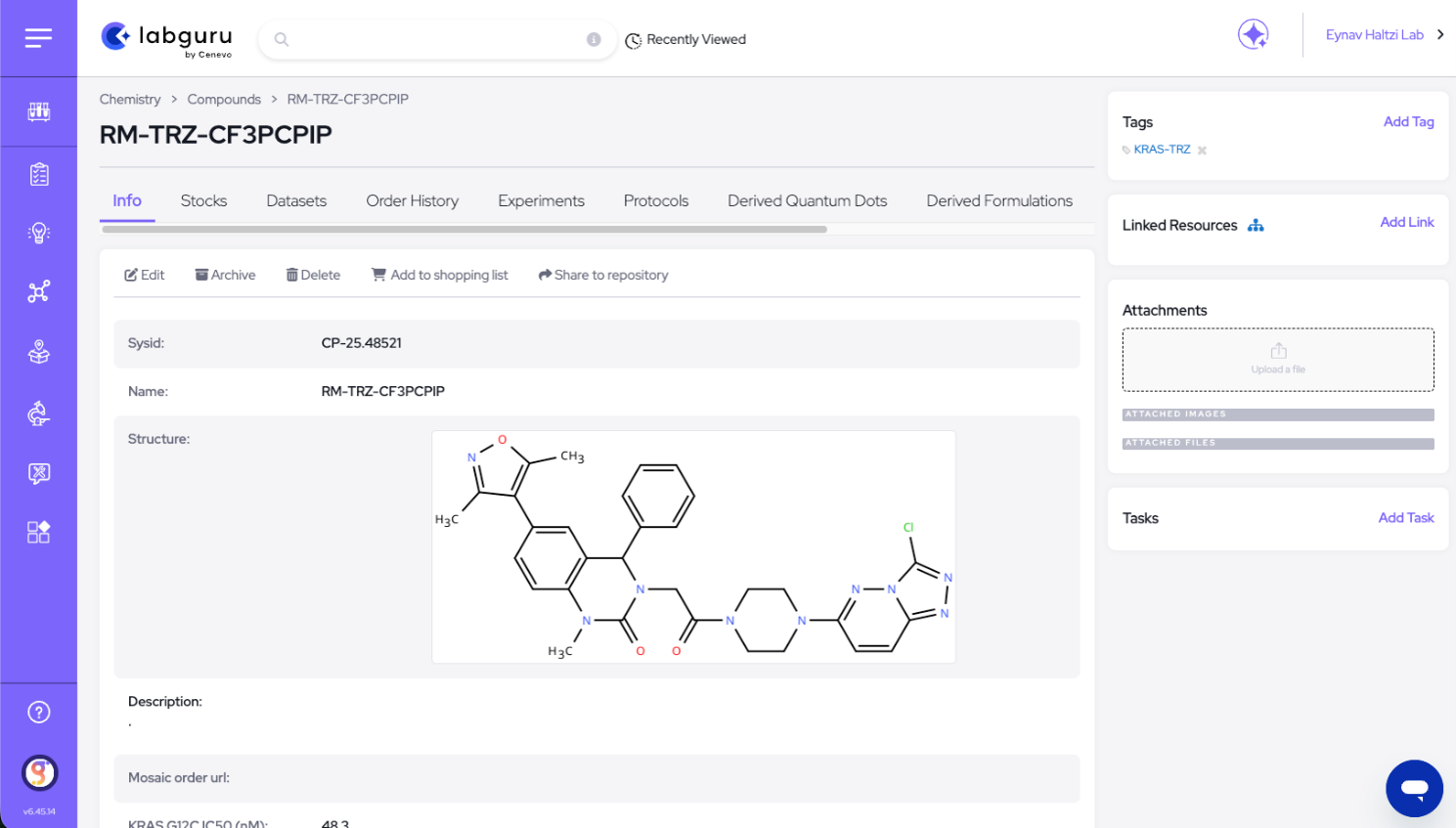
- Structure standardization generates a consistent, machine-readable version of each structure, normalizing stereochemistry, functional groups, aromaticity and geometry in alignment with FDA and IUPAC guidelines. The standardized form is saved as a calculated parameter; original structure input is always preserved
- Parent structure calculation automatically groups every registered compound with its related salts, solvates and isotopic forms, deriving the shared parent structure and linking each compound to it
.svg)
ELN Integration
Labguru connects your compound registry directly to your ELN experiments, protocols and inventory. Link compounds and samples to experiment records, navigate from any compound to every experiment that used it, and register newly synthesized compounds directly from reactions drawn in the notebook.
.svg)
Data Integrity and Governance
The fields that define compound identity in Labguru are read-only and system-calculated, so Parent Structure ID, standardized structure representation and calculated properties cannot be manually overridden. Every change is logged with a full audit trail, and background processing keeps registration fast without compromising data quality.
.svg)
Open API and Integrations
Labguru's documented REST API gives external systems direct, programmatic access to the compound registry. Instruments, databases, screening platforms and in-house pipelines can all exchange data automatically, with compounds registered, updated and retrieved through the same API.

Built on AI-Ready Foundation
Every compound is stored in a standardized, machine-readable form, with canonical structures, calculated properties and consistent identifiers. That clean data foundation supports a roadmap of chemistry AI capabilities, including automated data enrichment, structure recognition from images and instrument-file parsing.
Flexible Registration Workflows
Supporting every common registration workflow, with consistent data quality processing across all entry methods.
- Single registration: draw or import a structure using the integrated Ketcher structure editor and complete a configurable compound form
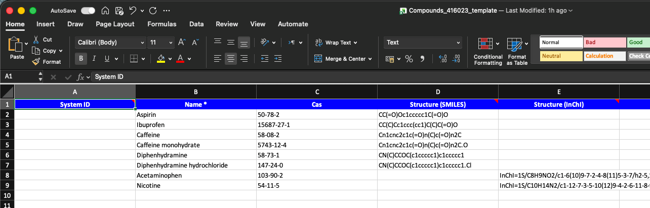
- Bulk registration via Excel: import compound libraries using an Excel template, with structures described using SMILES or InChI
- Bulk registration via SDF: import SD files through a guided wizard with step-by-step field mapping, the preferred route for large-scale library onboarding
- API-based registration: integrate external synthesis, screening or compound management systems programmatically, with structures passed via SMILES or InChI
Chemical Search and Data Retrieval
Labguru supports both structure-based and text-based search across your compound registry.
- Run exact or substructure searches across your entire compound collection by drawing or importing a query structure
- Navigate from any compound version to its parent structure to view the full compound family, including all related salts, solvates and isotopic variants
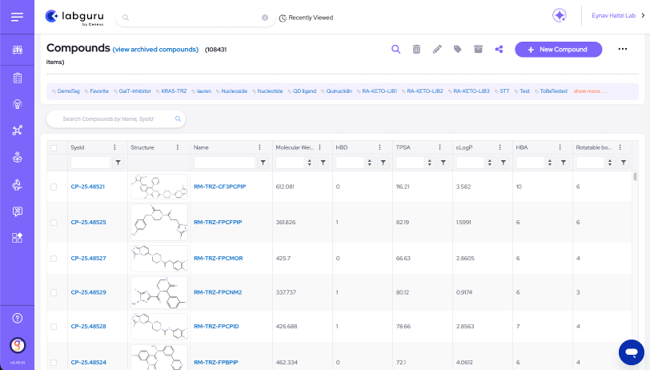
- Search by compound name, ID, SMILES, InChI or any custom metadata field using filterable index tables
- Check for related forms before synthesizing or purchasing a compound to avoid redundant resource expenditure